
 Solar Panel Efficiency Through The Years.
Solar panels were invented by Alexander Becquerel in 1839 and had an efficiency of about 1%.
Bell Laboratories came up with the silicon solar panel in 1954 with an improved efficiency of just over 4%. In 1960 Hoffman Electronics was successful in producing a photo electric cell with an efficiency of 14%.
The University of Southern Florida developed a thin film photovoltaic cell with an efficiency of just under 16% by 1992. By 2012 the efficiency of solar panels was approaching 18% which was achieved in June 2015 and before the end of that year, developments had improved solar panel efficiencies to fractionally over 22%. By 2016 the Swiss had achieved an efficiency rating in the laboratory of 29.8% and by mid 2017 efficiencies, exceeding more than 44%, were achieved in the United States of America.
The endless rising cost of grid electricity has made the production of solar panels for homes a viable business. The significant increase in production has led to a significant reduction in the cost of production due to the economies of scale that have seen the cost of photovoltaics drop by about 80% in the last 20 years.
Not only has the price come down but the efficiencies that have been achieved in laboratories around the world are now reflected in the panels that are commercially available for the average household. The commercially available panels that were on the market, even less than ten years ago, had efficiency ratings of perhaps 14.5% have now been replaced by panels that have efficiency ratings of over 20%.
Not only do they have a higher efficiency but they cost a lot less. I’m occasionally asked “what’s the best solar panel to buy”. My short answer is, “I don’t know”. The only way that anyone can know which panels perform the best requires that the photovoltaic panels be tested by a respected authority so that performance and build quality statistics can be compared with similar products.
The problem with that scenario is that the production of solar panels that don’t perform as well as competitors in the market place is terminated and a more efficient, and therefore competitive product, hits the assembly lines. Reliable testing of these products is tedious and time-consuming and the information becomes out of date and irrelevant within a very short amount of time as new and more efficient products enter the market.
The purchasing of second-hand panels from an upgraded system needs careful consideration because panels are becoming increasingly more efficient and even now they continued to be a little bit less expensive as time goes on.
In 1955 Hoffman Electronics marketed a silicon solar panel that had efficiency of only 2%. The units sold for $25 which was almost $1800 per watt. In 2018 you can buy commercial solar panels for only $4 per watt. Of course, in 1955, twenty-five bucks was a lot of money.
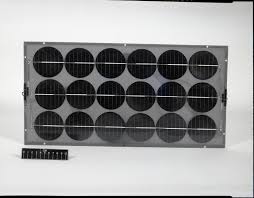 Obviously those panels are not sought after collector’s items. By the end of the 1950s, Hoffman Electronics had improved the efficiency of their panels to almost 10% and in 1960 an efficiency rating of 14% was achieved. The romance of getting off the grid and living like a hippie in the bush through the 1970s helped with the research and development inefficiencies of solar panels.
The significant reduction in production costs and the increase advancement in efficiencies has made solar panels for homeowners an increasing reality all around the world. As technology increases, the complexity of installing both standalone and interactive systems becomes less tedious and a seasoned team of skilled workers can install as many as three complete systems into homes in a single day.
So, is it possible for solar panels to become even less expensive and even more efficient? That has
most certainly been the trend over the last decade and I can’t see the trend stopping any time
soon. There was a concern that using silicon in panels had an efficiency limit of less than 30%, but
of course there are other materials that can be used to make panels. >> LEARN MORE >>
Solar panels manufactured from Perovskite allegedly have an efficiency ceiling of 33% but claims of 46% efficiency had been made. Then there’s the periodic table full of other elements that can be mixed and matched to produce materials with efficiencies we haven’t dreamt about yet. But we may not even need any materials anyway. Nicholas Tesla said “electric power is everywhere present in unlimited quantities and can drive the world’s machinery without the need of coal, oil, gas, or any other common fuels”.
What’s referred to as alternative energies including solar energy, has its place, and at this time it’s not only what the authorities permit, is what they are encouraging. It’s always difficult to evaluate the real cost of anything if someone subsidises it. But at the time being, it is what is available to the masses. Now with improved efficiencies, new systems can pay themselves off in three to four years and so they make very good economic sense.
John Lynn
Suburban Off Grid Living